On Pain
Chosen vs unchosen, chronic, tattoos
First, some announcements.
The Dry Season will be published in one month. Later in May, I’ll send a newsletter focusing on that, but for now: On May 22, I’m offering a free virtual craft session and reading for anyone who pre-orders the book. You can register here. There are links to order, and you can also order a personally signed copy of the book from Prairie Lights Books. Whether you care or not about a free craft session, I would be so grateful if you’d preorder the book, from wherever you buy your books.
My book tour is now scheduled and locked in. You can see the whole thing on my website, and reserve tickets for my events in New York City (with Leslie Jamison and Stephanie Danler!). I’m so excited to visit each of these 16 cities and to get to talk with some of my favorite people and writers along the way, like Maggie Nelson, Alexander Chee, Jessica Hopper, Kaveh Akbar, and lots of others. I hope you come out and say hi.
I taught a four-session class called “The Researched Memoir” last summer via Storystudio in Chicago, and the brilliant folks at Storystudio recorded and edited the class, and now you can purchase it as a self-paced course. I put so much heart and time into prepping this class, and have gotten terrific feedback on it so far. I hate that my teaching has to be so limited because time is finite, and am very grateful for this opportunity to make it accessible to larger numbers of people. If you take the class, let me know what you think! You can learn more and register here.
On Pain
Much of my body is tattooed and most of it was done in my early to mid-twenties, the years just after I got sober. Young Melissa tried to imagine what older Melissa would appreciate, or at least not regret, and mostly succeeded. My worst tattoo choices were the spontaneous ones and most of them ended up in my lower back area — a smudgy little cache of names that don’t mean the same things to me that they once did.
For the last fifteen years, I’ve been tattooed only a few times, each when life reached a dramatic volta and there was a lesson I wanted to remember or memorialize. Sometimes I forget that I’m a tattooed lady and what that means to some people, though it means less now than it ever has before.
Recently, I finally decided to get a big cover-up on my lower back. Cover-ups are necessarily much larger than the tattoos they cover and this one would span my whole lumbar region, from my crack up to my waist. As the appointment approached, I felt excited. I had only positive associations to the experience of getting tattooed, and lots of them.
I remembered that they always hurt more than I thought they would, at first. Then, the endorphins kicked in. I had spent many hours listening to the buzz of the tattoo gun, smelling ink and blood and the black nitrile gloves that artists wear, and watching images bloom onto my body. I loved staring at the drawings tacked all over the walls, feeling the rise of yummy brain chemicals inside me, and the wasted feeling I had afterward, how deeply I slept, and the rituals of cleaning the wound for days afterward. It was a way of moving into my body, and also proving that I could control it—two things I craved in my early twenties. Withstanding pain was its own high back then, and I was proud of my stoicism, the way I could drift away and not really feel it after a while.
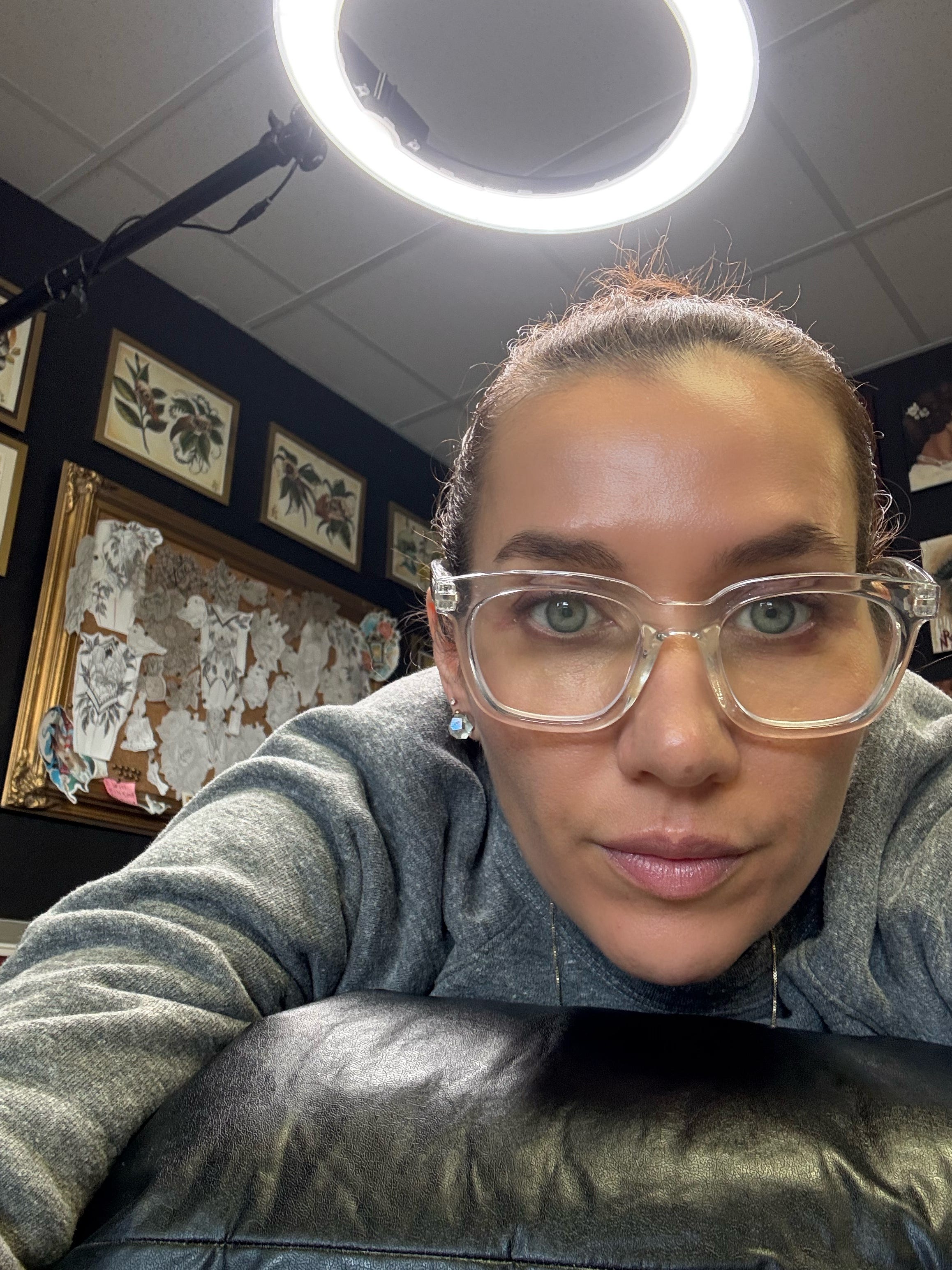
The day before my appointment, I suddenly felt nervous. I only vaguely remembered getting the original tattoos, but I did remember them being particularly uncomfortable because I am ticklish on my back, especially the right side. It also occurred to me that my lower back had been through some trauma in recent years and might be even more sensitive. Finally, I would be sitting for three, 3-4 hour sessions, longer than I’d ever sat before. I didn’t know if the endorphins would last that long, and now I’m glad for my ignorance. If I’d known what was in store, I probably would have canceled the appointment.
Back in 2020, like many of us, I had a very rough year. In July of 2020, in the midst of a global pandemic, my wife and I moved from NYC (my home for more than 20 years) to Iowa City. We started new jobs, fully online. The election loomed. Running, which had been a huge factor in my mental health for most of my life, became a lifeline, and then a problem. In our first months in the Midwest, I was running upwards of ten miles per day. Sometimes I would run ten miles in the early morning, and then five more in the late afternoon. Like most bottoms that I’ve hit, I didn’t manage to see it rushing toward me until I was laid out.
The pain mounted for months, but I found ways to manage it. I needed running too much to face that it was harming me. I ran until I physically couldn’t anymore. Eventually, I was in so much pain that I could not walk, stand, or sleep. I had experienced myriad forms of physical pain before, but nothing like this. Nothing assuaged it. I did not know how to treat it, when or if it would end. This unknowing began to contort my mind in frightening ways.
After a long stretch of terror and attempts to figure out the source, I learned that I had a severely herniated spinal disc, which had led to a terrible case of sciatica. One doctor described my spinal disc as a jelly donut that had been smashed (by all that pounding on pavement) and was leaking battery acid onto a whole bundle of nerves, which was causing the relentless pain that churned down my buttock and hip and leg into my foot. (If I could draw, I would draw for you the image of the battery-acid donut that lives in my mind.)
I wrote at more length about that experience in this newsletter. Suffice it to say here, those were a life-changing two years. My pain might not have ended, and I would have learned how to live with that; many heroic people do. I am very grateful that it passed. When I began acupuncture early in my recovery, the first needle in my lower back prompted me to burst into ragged tears, as if I were a balloon full of grief. Now, three years after my last debilitating episode, the prospect of facing many, many more needles in that same area, well.
The first session began all right. I straddled a chair, hugging its back while Nikki, the artist, tattooed the whole outline and some shading. The pain was astounding—much worse than anything I remembered from my youth. A white-hot scalpel, drawing its lacerations slowly around my most vulnerable area. The fact of not being able to see her as she worked exacerbated the pain. Still, in the beginning I was able to text a few friends, squeeze out some jokes about my suffering.
Look, I have a longtime meditation practice. I know about somatic methods. I tried to make friends with the pain. I turned toward it. I willed my body to relax, to soften. It was impossible. I tried to read my book. I tried to leave my body. No matter how I attempted to mitigate my physical experience through my own attention, it was just me and the pain, locked together.
Eventually, I developed a kind of rhythm, breathing in when Nikki paused to swipe away the blood and excess ink every 20 seconds or so, and then exhaling slowly as she resumed her brutal work. Pilates and years of working out had conditioned my breathing this way, and it gave me something to do. I tucked my face into my elbow and gripped the chair’s leather upholstered back so tightly that my arms, shoulders, and lateral muscles would be tender for days afterward. After about 2.5 hours, we took a short break.
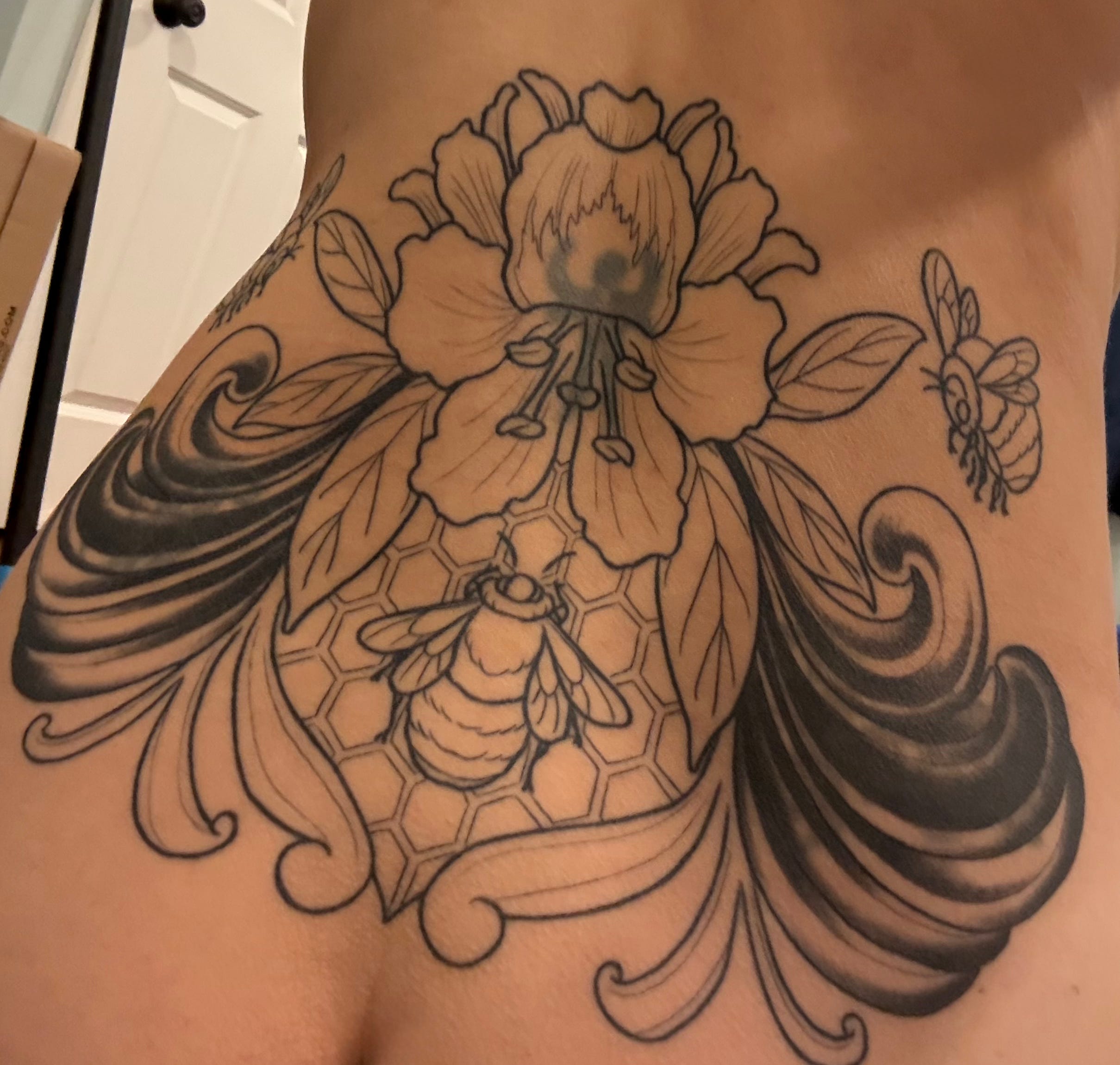
I ate a protein bar, drank some water, and peed. I studied my back in the mirror and admired her work. I tried to imagine how I would get through another ninety minutes. I understood simultaneously that I could not, but also that I would. There were two wills in me, and one the stronger. It didn’t feel vexed, this battle. Not a street fight but a wrestling match. My body could only mount its own argument, then accept the outcome. I got back onto the chair.
Later, my Chinese medicine practitioner would explain that the body in pain only produces endorphins for about two hours, but by then I already knew.
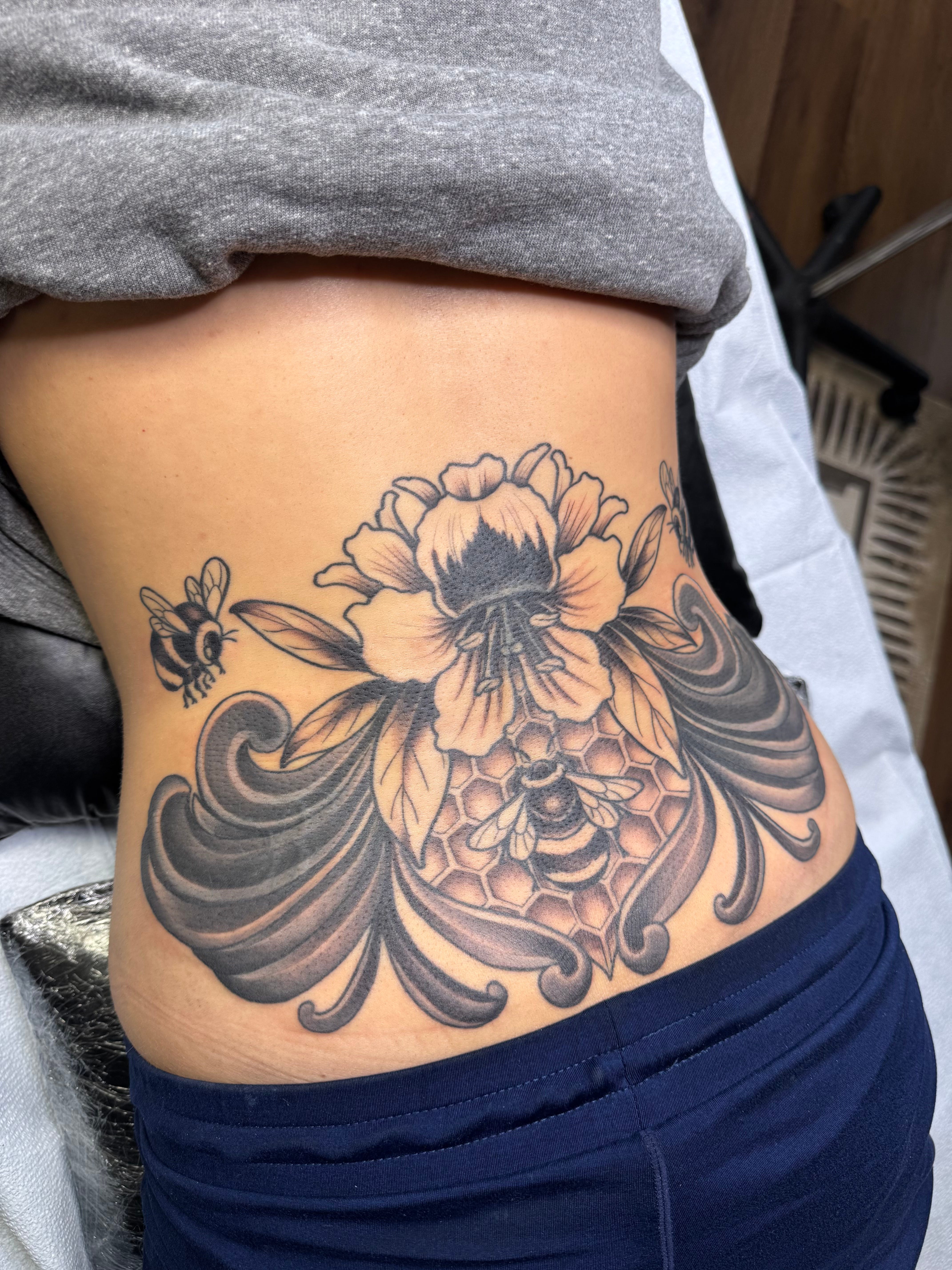
The tattoo features a rhododendron flower with two bumble bees floating parallel on either side of my waist — exactly, I later confirmed, over my kidneys. Nikki had saved these for last for artistic reasons, not sadistic ones, but they would have suited either objective. About thirty minutes into this second half of the session, my hands began to shake. No longer did I fluctuate in and out of the worst of the pain, no longer did my breathing distract me. I was counting the seconds now. This is unbearable, I thought.
I was reaching the outer limit of what I could withstand. If Nikki had been torturing me for information, I would have given it up. But it wasn’t Nikki who held me captive. It was me. What a strange position to occupy. I mean, I had done so many times before. I had been captive to my own addiction to heroin, more than twenty years ago. Ten years later, an addiction to a person. But I had never so consciously chosen to remain in such acute pain. I had lost my agency in both of those experiences. Like Bruce Banner and the Hulk, or Severence’s innies and outies, my selfhood split—neither side able to hold the consciousness of the other. Even in my addiction to running, my denial had been a wall that divided the powerless part of me from the injured.
This was different. I was integrated with my hurting part. I knew that I could stop at any point. I was not powerless. I asked myself if this pain was worse than the relentless pain of the sciatica, which had regularly made me weep tears of terror and fantasize about suicide. Physically, it was comparable. The difference was that the sciatica pain had been attended by terror. It had happened to me. Whereas I had chosen this pain. I was not afraid.
It was clear to me that this pain, whether I reached my threshold or not, was a wholly different experience from any of those past torments. One that only two decades sober and three decades of therapy had made possible. Pain is unavoidable, but it is a luxury to get to choose yours. In a weird way, withstanding this chosen pain felt like an homage to my past self, to all the pain she dumped down the drain of her own powerlessness. A memorial to all the work I had done to make it so I never suffered that way again. Of course, there will be other pains to come, ones that choose me, whether I want them or not. But hopefully not the kind where my one hand does the harm while the other salves the wound.
I was on the brink of asking Nikki to stop when she finally did. I was on that brink for 90 minutes. When I lifted my head there was a wet circle on the paper covering the chair’s back where I had drooled while biting the inside of my arm. She cleaned me up and I gathered my things and paid her.
Just as I was tucking the aftercare instructions into my pocket, a darkness started to frame the edges of my vision. Nausea rose in my gut. I spent the next fifteen minutes hugging the studio’s toilet, retching, while trying to maintain consciousness. Finally, I swallowed some juice and pulled myself together. My protein bar had been woefully insufficient. I felt embarrassed, like an amateur, but also satisfied by this very reasonable bodily response to what I had undergone.
When I got home, I was still trembling, but quietly jubilant. Oh, for my worst pain to be a chosen one. To know that I will not suffer again tomorrow. That, for the time being, I will not suffer at the hand of my own addictions. To be middle-aged and feel it all. To revel in my body’s lack of stoicism. To know that I will I bring better snacks to the second and third sessions. That I can stop if I want to, but won’t.
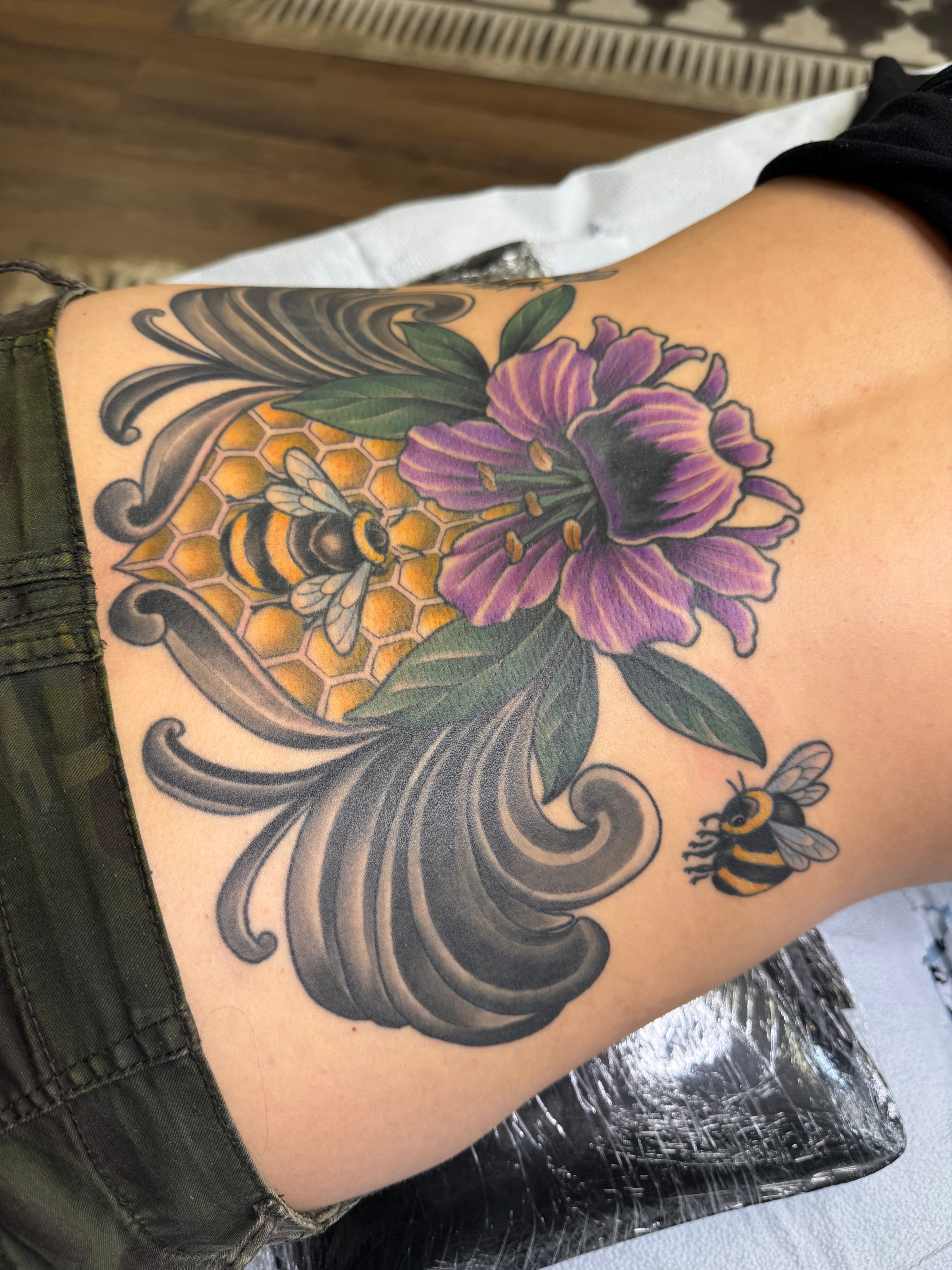
(Check out Nikki’s studio here.)
That tattoo is gorgeous. I’ve been thinking about getting my first tattoo after many years, a middle-aged woman myself.
The ink is stunning... and on a perfect bit of canvas..🔥👀